Principais conclusões
- Root cause of breakage: The main reasons for the breakage of correntes de esteira de escavadeira are concentrated in overload impact, abnormal pitch wear, improper tension adjustment, lubrication failure, e material metal fatigue.
- Precise diagnosis: Regularly using an ultrasonic flaw detector to check for internal cracks and using a pitch gauge to monitor the track chain pitch extension rate (replacement is needed when it exceeds 3%) can prevent more than 80% of sudden breakage accidents.
- Avoiding losses: Unplanned downtime caused by track chain breakage results in an average economic loss of $150-$300 per hour; implementing standardized preventive maintenance is the key to reducing the total cost of ownership (TCO).
- Quality selection: Purchasing high-quality correntes para escavadeiras requires paying attention to the case hardness depth e forging process; GFM utilizes aço premium de alta resistência e comprehensive heat treatment technology, providing a quality warranty of não menos que 1 ano ou 2.000 horas.
In heavy construction machinery operations, correntes de esteira de escavadeira are core undercarriage components that bear the weight of the whole machine and transmit driving traction forces. The breakage of track chains not only causes immediate site paralysis, but also potentially leads to secondary damage to sprockets, idlers, and the undercarriage frame.
The core reasons behind the breakage of correntes para escavadeiras lie in stress concentration caused by heavy load impacts, pitch elongation caused by wear under severe working conditions, abnormal shear forces caused by improper track tension, e dry friction burning caused by a lack of lubrication between pins and bushings. Through scientific tension management, regular pitch inspections, and selecting high-strength chains that have undergone deep heat treatment, breakage risks can be effectively eliminated, significantly extending the overall service life of the undercarriage system.
5 Core Causes of Excavator Track Chain Breakage
correntes de esteira de escavadeira operate in high-load environments, enduring multiple composite stresses such as tension, bending, impact, and friction. In-depth analysis of chain failure mechanisms reveals the following five primary objective factors:
1. Severe Impact and Overload Stress
When an excavator works under harsh working conditions such as mines and quarries, the tracks frequently drop or strike hard rocks. The instantaneous impact loads generated can reach 2.5 to 3.5 times the rated tensile force. This overload stress directly exceeds the yield strength limit of the chain link, causing link fractures or pin hole deformation.
2. Pitch Elongation and Wear Accumulation
As operating time increases, the contact surfaces between the chain pins and bushings experience natural wear. This wear causes the chain pitch to gradually elongate. According to construction machinery track wear standards, when the pitch elongation rate exceeds 3%, the meshing relationship between the chain and the sprocket segments is destroyed, causing severe “riding” phenomena. This generates enormous additional shear forces, ultimately leading to fatigue breakage of the correntes para escavadeiras.
3. Improper Tension Adjustment
- Too tight: Excessively high track tension puts the interior of the chain in an extremely high pre-stress state, accelerating dry wear between pins and bushings, causing the chain to break when subjected to minor external impacts.
- Too loose: Overly loose tracks cause the chain to experience severe jumping and swaying during travel, increasing the risk of track derailment. The instant derailment occurs, the chain links are extremely susceptible to being snapped.
4. Lubrication Failure and Dry Friction Burning
Sealed and lubricated track chains rely on internal high-temperature grease and seals to maintain pin lubrication. Once seals are damaged by aging, wear, or foreign object intrusion, grease leaks out, and sand and muddy water seep inside, forming a highly abrasive “grinding paste.” This not only increases the wear rate by 5 to 8 times, but also causes pins to anneal and soften due to intense heat from dry friction, leading to breakage.
5. Material Defects and Uneven Heat Treatment
Low-quality chains often use ordinary carbon structural steel and lack rigorous heat treatment processes. If the surface hardened layer is too shallow (less than 4mm) or core hardness is insufficient, the chain cannot balance external wear resistance with core toughness, making it easy for micro-cracks to form and rapidly expand under long-term alternating stress, leading to overall fracture.
| Failure Phenomenon | Core Cause | Potential Risk | Preventive Suggestion |
| Pitch Elongation > 3% | Internal pin/bushing wear | Sprocket riding, chain breakage | Measure pitch every 200 hours, turn or replace in time |
| Cracks on Link Surface | Overload impact, insufficient toughness | Sudden chain breakage, undercarriage breakdown | Avoid high-speed impact on rocks, select forged chains |
| Pin Burning/Seizure | Dry friction due to seal failure | Rigid chain bending, stress concentration breakage | Check seal conditions, clean mud off chains |
| Frequent Track Derailment | Tension too loose or worn guide plates | Chain snapped, undercarriage parts damaged | Maintain standard sag (typically 30-50mm) |
💡 Perguntas frequentes
Q: Why does track chain elongation lead to breakage?
A: Track chain elongation is not caused by the stretching of the metal in the chain links themselves, but rather by severe wear on the link contact surfaces between the pins and bushings. This wear increases the clearance between the pins and bushings, which accumulates across the entire chain as total pitch elongation. Once the pitch elongates, the meshing between the chain and sprocket teeth misaligns, generating violent impact shear forces that ultimately cause the chain to break.
Q: What are the advantages of high-strength forged chains under complex working conditions?
A: Compared to ordinary cast chains, high-strength forged chains improve the internal grain structure of the metal through high-temperature forging and eliminate internal defects, increasing tensile strength by over 30% and fatigue life by over 50%. Under heavy-impact working conditions such as quarries, gravel, and frozen soil, forged chains can withstand extremely high instantaneous overloads without brittle fracture.
Professional Methods for Diagnosing Chain Damage
The key to preventing sudden breakage of correntes de esteira de escavadeira lies in establishing a standardized non-destructive testing and wear assessment system. Through professional tools and objective indicators, hidden dangers can be identified in their early stages.
Recommended Professional Inspection Tools
- Ultrasonic Flaw Detector: Used for non-destructive internal inspection of chain links and pins, capable of accurately identifying internal micro-cracks and metal fatigue damage invisible to the naked eye.
- Track Pitch Gauge: Measures the total length across 4 to 6 continuous links to calculate the average pitch elongation rate, serving as an objective basis for evaluating remaining chain life.
- Portable Leeb Hardness Tester: Measures chain rail surface hardness on-site to verify whether the heat-treatment hardened layer has been completely worn away.
Standardized Inspection Process
- Visual Inspection: Clean mud off the chain, check both sides of the chain links for visually detectable micro-cracks, severe collision marks, or pin retention failure.
- Sag Measurement: Park the excavator on flat ground, drive forward a short distance, and stop. Measure the sag at the top middle position of the track. Standard sag should typically be maintained between 30mm and 50mm.
- Abnormal Temperature Detection: After continuous equipment operation, scan various chain sections with an infrared thermometer. If a pin area shows a noticeably elevated temperature (exceeding 90°C), it indicates seal failure in that area and severe internal dry friction.
💡 Perguntas frequentes
Q: How to accurately measure excavator chain pitch wear?
A: To measure, park the excavator on flat ground so that the upper section of the track is in a tensioned state. Use a caliper to measure the center distance across 4 consecutive pins (which equals the sum of 3 pitches), and divide the measured value by 3 to obtain the actual pitch value. Compare this figure with the standard pitch of a new chain; when the pitch elongation rate reaches 3%, it indicates that chain wear has reached its limit and repair or replacement is required.
Standard Operations to Extend Chain Service Life
In addition to product quality itself, daily operations and standardized maintenance play a decisive role in the service life of correntes para escavadeiras.
1. Strictly Control Operating Terrain and Driving Habits
- Avoid long-term operations with one side of the track at a high tilt angle to reduce offset stress on the chain.
- Avoid frequent high-speed spin turns, which create immense torsional shear forces between the chain and track shoes.
- Reduce travel speed when driving on rocky or hard ground to reduce severe impacts on the undercarriage.
2. Establish a Dynamic Tensioning Adjustment Mechanism
Different working conditions have completely different requirements for track tension:
- Muddy/Clay conditions: Slightly loosen the tracks, as mud will accumulate between the chain and wheel sets, causing the tracks to be extra tensioned.
- Hard rock conditions: Maintain standard or slightly tight tension to prevent rocks from jamming between chain links, causing chain deformation or snapping.
3. Regular Cleaning and Intervention Maintenance
Clean mud, sand, and ice off the undercarriage daily after operations. When chain pitch wear is measured near its limit value, perform a “pin and bushing turn” service to turn the unworn sides to the working face, extending the total service life of correntes de esteira de escavadeira by 30% to 50%.
Best Practices for Undercarriage Parts Procurement
For undercarriage parts buyers and equipment managers, purchasing high-quality correntes de esteira de escavadeira must be based on strict technical parameter audits rather than relying solely on price comparisons.
1. Material and Heat Treatment Specifications
High-quality track chains should use alloy steel with high hardenability (such as 35MnB ou 40Mn2). Procurement must focus on auditing the heat treatment process parameters of the product:
- Link surface hardness: Should reach HRC 50-58 to ensure extremely high wear resistance.
- Case hardness depth: Effective hardened layer depth should reach 8 mm a 12 mm.
- Core toughness: Core hardness maintained at HRC 30-38 to absorb severe impact loads and prevent overall brittle fracture.
2. Precision Matching and Dimensional Consistency
Chain pitch tolerance must be strictly controlled within ±0,05 mm. Excessively large pitch tolerances lead to uneven load distribution among chain links, accelerating wear and causing localized stress concentration breakages. Buyers must require suppliers to provide complete inspection reports and dimensional tolerance descriptions.
💡 Perguntas frequentes
Q: Can track chains from different excavator brands be interchanged?
A: Even for excavators of the same tonnage across different brands, undercarriage design parameters such as pitch, pin diameter, link height, and mounting hole spacing may differ. Therefore, they cannot be interchanged blindly. However, specialized undercarriage factories like GFM can manufacture precisely according to specific model parameters of different brands (such as Caterpillar, Komatsu, Sany, etc.), ensuring 100% perfect fit with original undercarriage structures.
GFM High-Strength Chains and Factory Manufacturing Advantages
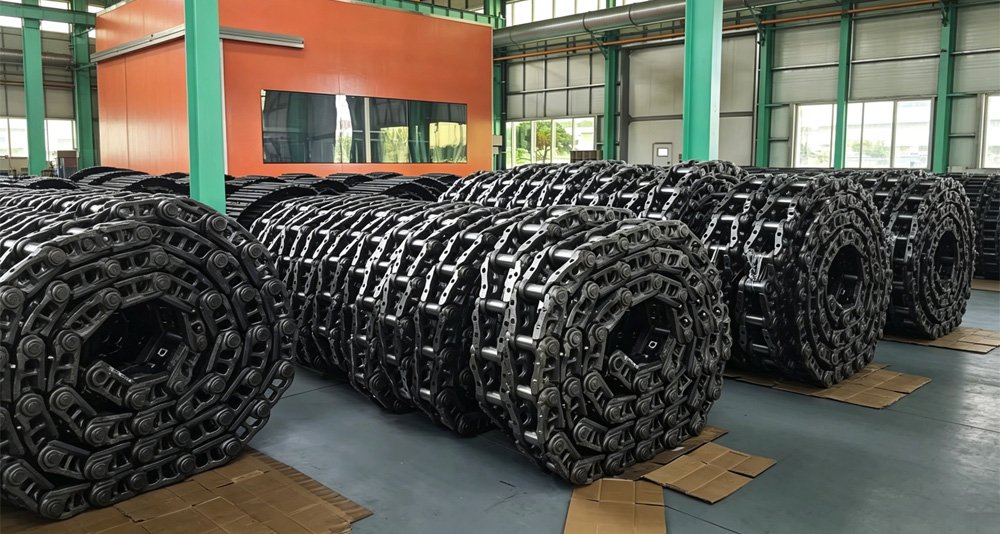
As an experienced heavy machinery parts manufacturer, GFM has focused on the R&D and precision manufacturing of excavator and bulldozer undercarriage parts since 2011. Addressing industry pain points where correntes de esteira de escavadeira break and wear easily in harsh working conditions, GFM relies on deep manufacturing heritage and advanced production lines to provide global customers with highly durable track chain solutions.
1. Premium High-Strength Steel and Forging Process
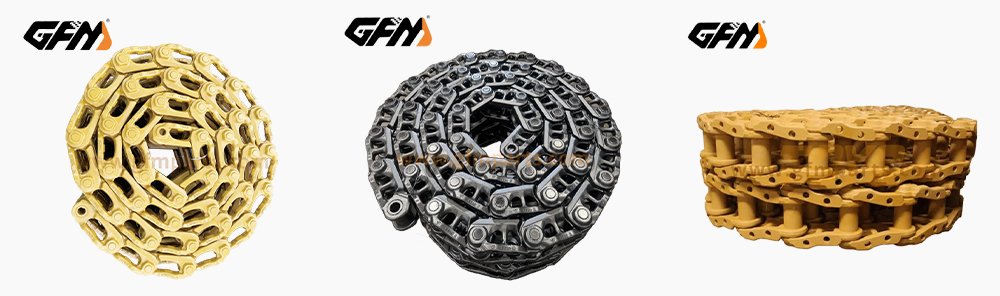
GFM correntes para escavadeiras strictly select premium high-strength alloy steel materials and utilize advanced precision forging processes, eliminating internal material defects such as air holes and slag inclusions from the source. Combined with GFM’s independently developed overall quenching and medium-frequency induction heating technology, it ensures that chain links have a hardened layer depth of over 10mm with high hardness, while retaining a highly tough core structure, perfectly balancing wear resistance and impact resistance.
2. Full Compatibility with Mainstream Brands
GFM possesses strong R&D and mold development capabilities. The manufactured correntes de esteira de escavadeira are perfectly compatible with mainstream excavator brands and models on the market, including Komatsu, Hitachi, Caterpillar, Volvo, Kobelco, Daewoo/Doosan, Hyundai, Kubota, Bobcat, Yanmar, Sany, Liugong, XCMG, Shantui, and more. Whether standard, heavy-duty, or mining types, GFM achieves precise fit.
3. Outstanding Warranty Commitment and Rigorous QC
GFM provides a quality warranty period of não menos que 1 ano ou 2.000 horas for every corrente de esteira para escavadeiras sold. The factory has established a complete quality control system, ranging from spectral material analysis and ultrasonic flaw detection to tensile strength testing and 3D coordinate dimensional inspection, ensuring every batch delivered meets or exceeds international industry standards.
4. Strong Large-Scale Capacity and Global Delivery
Equipped with automated production lines and high-precision machine tools, the factory possesses the capacity to efficiently handle pedidos de grande volume and customized projects. With mature supply chain management and an experienced international logistics team, GFM guarantees efficient production cycles and timely delivery of high-quality undercarriage spare parts to domestic and overseas buyers and partners.
| Obtenha um orçamento rápido e gratuito | E-mail: henry@gfmparts.com | Whatsapp: +86 17705953659 |
Don’t let sudden chain breakage halt your project progress! Leveraging professional manufacturing experience since 2011, advanced heat treatment processes, and a commitment to quality for não menos que 1 ano ou 2.000 horas, GFM provides you with cost-effective, highly wear-resistant correntes de esteira de escavadeira solutions.
Contact GFM’s professional engineering team to get a free quote and customized product catalog!