Оглавление
- Structure and Operating Mechanism of the Excavator Idler Wheel
- Common Failure Types and Root Cause Analysis of Excavator Idler Wheels
- How to Scientifically Maintain Excavator Idler Wheels to Extend Service Life
- Key Criteria for Selecting Reliable Excavator Idler Suppliers
- GFM Excavator Idler Wheel Manufacturing Strength and Quality System
Structure and Operating Mechanism of the Excavator Idler Wheel
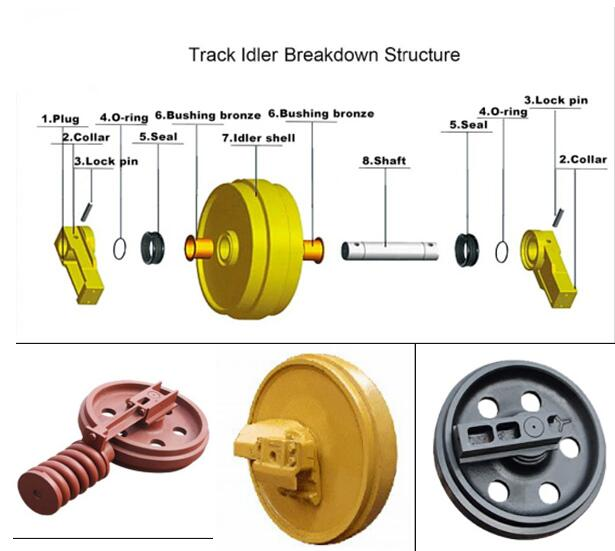
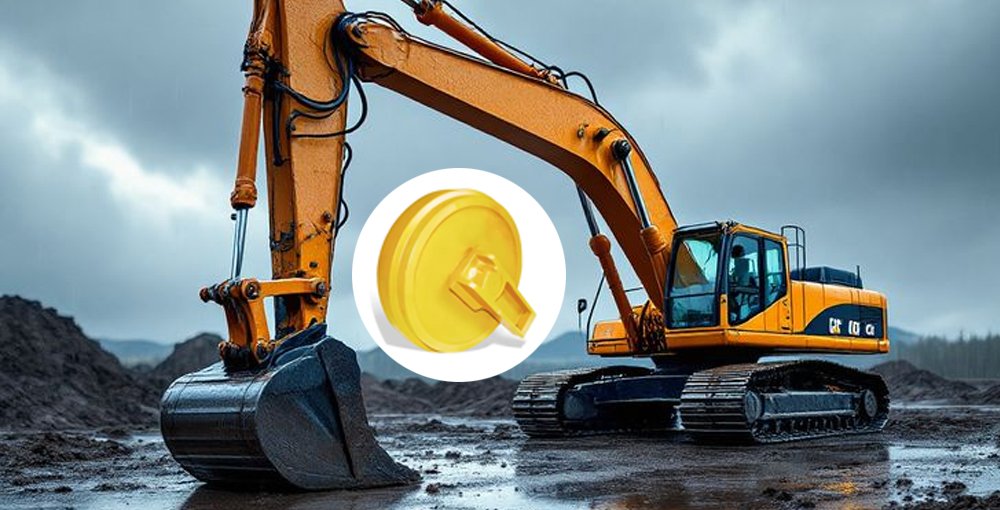
The экскаваторное направляющее колесо is a key guiding and tensioning component in the tracked undercarriage system, playing a vital role in guiding track movement, maintaining stable tension, and cushioning impacts. Under complex working conditions, its structural reliability directly affects the overall machine operating efficiency and track life.
Core Structural Composition: High-Strength Integrated Load-Bearing System
The excavator idler wheel is typically composed of three key functional modules, each of which directly influences durability and performance:
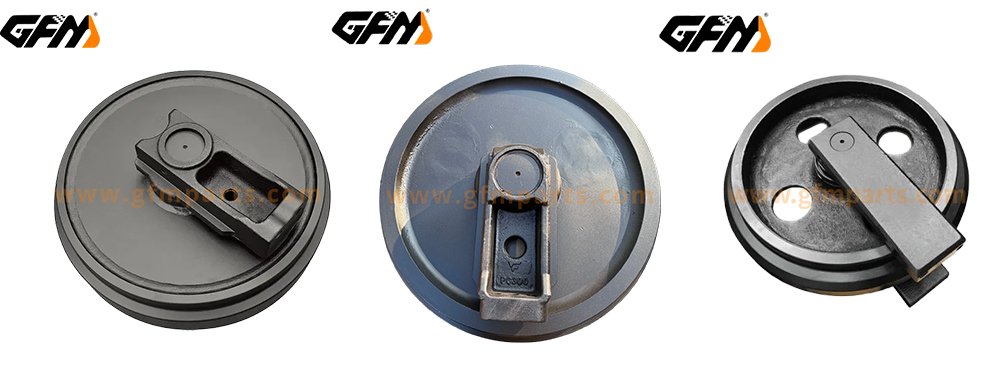
- Wheel Body: Manufactured from high-strength alloy steel or ductile iron, the wheel body serves as the primary load-bearing component. Through integrated forging and precision machining, GFM enhances fatigue resistance and wear performance, enabling stable operation in heavy-duty conditions such as mining and earthmoving applications.
- Bearing and Shaft Assembly: This system enables smooth rotation while bearing radial and impact loads from the track system. Machining accuracy and fit tolerance are critical factors that determine whether the idler operates smoothly without abnormal noise or overheating.
- Система уплотнения и смазки: Dual floating-seal structure is used to retain grease inside the bearing chamber while effectively preventing ingress of mud, water, and dust. In real-world applications, this system is one of the most critical factors determining service life.
Operating Mechanism: Three-Stage Dynamic Working Process
The excavator idler wheel is not a static component; it operates continuously as part of a dynamic mechanical system. Its working process can be divided into three stages:
- Track Guiding Stage: Positioned at the front of the track system, the idler wheel guides the track chain along the correct trajectory, preventing misalignment or derailment and ensuring stable machine movement.
- Tension Balancing Stage: Working together with the track tensioning cylinder, the idler wheel continuously adjusts track tension within an optimal range. Insufficient tension may cause skipping, while excessive tension accelerates wear on both the track and idler.
- Shock Absorption Stage: In rough terrains such as gravel, mud, or uneven ground, the track system generates intermittent impact loads. The idler wheel absorbs part of these forces through its bearing structure and wheel elasticity, reducing stress transmitted to the drive system.
Engineering Reliability Key Factors
Based on GFM’s long-term manufacturing experience and global application feedback, the reliability of an excavator idler wheel depends mainly on three critical factors:
- The ability of the sealing system to effectively prevent mud and debris ingress over long-term operation
- The strength and fatigue resistance of the wheel body material under high-impact conditions
- The compatibility between the bearing system and lubrication design with actual working loads
Failure in any of these areas can significantly shorten service life or even lead to unexpected machine downtime. Therefore, in procurement and selection, manufacturing processes and material standards are far more important than simple dimensional matching.
Common Failure Types and Root Cause Analysis of Excavator Idler Wheels
In an excavator undercarriage system, the excavator idler wheel operates under continuous heavy loads, impact forces, and harsh working environments such as mud, dust, water, and extreme temperatures. Therefore, its failures are rarely caused by a single factor. Instead, they result from a combined effect of material performance, sealing integrity, lubrication conditions, and working environments.
Bearing Damage and Seal Failure as the Core Failure Mode
The bearing system is one of the most vulnerable critical components in an excavator idler wheel. Typical symptoms include abnormal noise, overheating, increased rotational resistance, and even complete seizure.
Main causes include:
- Seal failure allowing mud and water ingress, which contaminates the lubrication system
- Insufficient or degraded grease, leading to poor lubrication performance
- Long-term heavy-load operation exceeding the bearing’s fatigue limit
- Installation misalignment causing uneven stress distribution and accelerated localized wear
According to GFM after-sales data, approximately 65% or more of bearing failures are directly related to seal system issues. Once the sealing system fails, contaminants rapidly accelerate internal wear, often leading to irreversible damage in a short period of time.
Structural Wear, Track Deviation, and Operational Abnormalities
In addition to bearing-related issues, excavator idler wheels may also experience structural wear and operational instability during long-term use. Common symptoms include track misalignment, abnormal vibration, and uneven wheel surface wear.
Typical causes include:
- Long-term impact loads causing uneven wear or reduced roundness of the wheel body
- Improper track tension adjustment (too tight or too loose), resulting in loss of alignment stability
- Increased bearing clearance, causing radial runout during operation
- Extreme working conditions (mining, rocky terrain, muddy environments) accelerating fatigue accumulation
- Uneven wear of the track chain, further amplifying misalignment issues
These issues typically do not occur suddenly but develop gradually over time. If early warning signs such as slight deviation or intermittent vibration are ignored, they may eventually lead to severe idler wheel damage and abnormal wear of the entire undercarriage system.
How to Scientifically Maintain Excavator Idler Wheels to Extend Service Life
The excavator idler wheel is a high-load and high-wear component in the excavator undercarriage system. Its service life depends not only on manufacturing quality but also on proper daily maintenance practices. Scientific maintenance can significantly reduce failure rates, extend service life, and minimize unexpected downtime. Based on GFM’s global field experience, proper maintenance can improve idler wheel lifespan by approximately 20%–35%.
Regular Inspection and Preventive Maintenance System
The foundation of scientific maintenance is establishing a stable inspection schedule instead of adopting a “repair after failure” approach.
Recommended inspection intervals:
- Basic inspection every 250–500 operating hours
- Comprehensive inspection and lubrication check every 1000 hours
- For mining or high-dust environments, shorten the interval to within 200 hours
Key inspection items include:
- Abnormal noise or vibration during operation
- Uneven wear or cracks on the wheel surface
- Signs of oil leakage or mud ingress around sealing areas
- Looseness or misalignment of mounting bolts
Based on GFM’s long-term customer feedback, early detection and correction of minor issues can prevent more than 70% of severe idler wheel failures.
Lubrication and Sealing System Maintenance
The lubrication and sealing system is the core factor determining the service life of an excavator idler wheel. Once compromised, internal bearings quickly enter irreversible wear conditions.
Key maintenance actions include:
- Regularly check grease condition to prevent oxidation or thermal degradation
- Use high-temperature and high-pressure resistant grease suitable for working conditions
- Ensure sealing integrity to prevent mud and water from entering the bearing chamber
- Increase inspection frequency in high-humidity or high-dust environments
From an engineering perspective, over 60% of early idler wheel failures are directly related to insufficient lubrication or seal damage. Therefore, maintaining a stable lubrication environment is more critical than frequent component replacement.
Proper Installation and Operating Condition Management
Even high-quality excavator idler wheels can experience significantly reduced service life if installed or operated incorrectly. Therefore, installation accuracy and working condition management are essential parts of the maintenance system.
Key operational recommendations:
- Ensure precise alignment during installation to avoid axial load imbalance
- Use torque tools to tighten bolts properly and prevent loosening or stress concentration
- Regularly check track tension to avoid over-tight or over-loose conditions
- Avoid prolonged heavy-load continuous operation whenever possible
- Increase inspection frequency in rocky or extreme working environments
GFM field data shows that correct installation and proper tension management can reduce abnormal wear by 15%–25%, while significantly lowering overall undercarriage maintenance costs.
Key Criteria for Selecting Reliable Excavator Idler Suppliers
In the excavator undercarriage procurement system, the selection of поставщики натяжителей экскаваторов directly affects machine operating stability, maintenance costs, and downtime risk control. Based on GFM’s manufacturing and global supply experience since 2011, evaluating a qualified supplier should focus on system-level capabilities rather than price comparison or single-parameter matching.
- Full In-House Undercarriage Manufacturing Capability: Reliable suppliers typically have complete production capabilities for core undercarriage components such as idler wheels, sprockets, and track rollers. They do not rely heavily on outsourcing critical processes, which ensures better consistency and batch-to-batch stability.
- Engineering-Grade Material Standards: High-quality excavator idler wheels must be made from high-strength alloy steel or premium cast steel with stable material composition control. Otherwise, early fatigue failure or cracking may occur under high-impact working conditions.
- Mature and Stable Heat Treatment Processes: Professional suppliers usually apply standardized heat treatment processes, such as controlled quenching and tempering, to achieve a balanced combination of hardness and toughness, preventing issues such as brittleness or excessive wear.
- Comprehensive Quality Inspection System: Reliable suppliers should have complete testing capabilities, including dimensional accuracy inspection, hardness testing, and fatigue performance evaluation. Strict quality control before shipment is essential to reduce batch inconsistency risks.
- OEM/ODM Adaptability and Brand Compatibilit: High-level excavator idler suppliers are typically able to support multiple mainstream equipment brands such as Komatsu, Caterpillar, Hitachi, Volvo, and SANY. They also provide customization for different machine models, improving compatibility and application efficiency.
- Delivery Capacity and Long-Term Supply Stability: Stable supply capability includes support for small trial orders, large-scale continuous production, and reliable lead time control (e.g., a 30-day delivery system). This is critical for ensuring uninterrupted operation in engineering projects.
GFM Excavator Idler Wheel Manufacturing Strength and Quality System
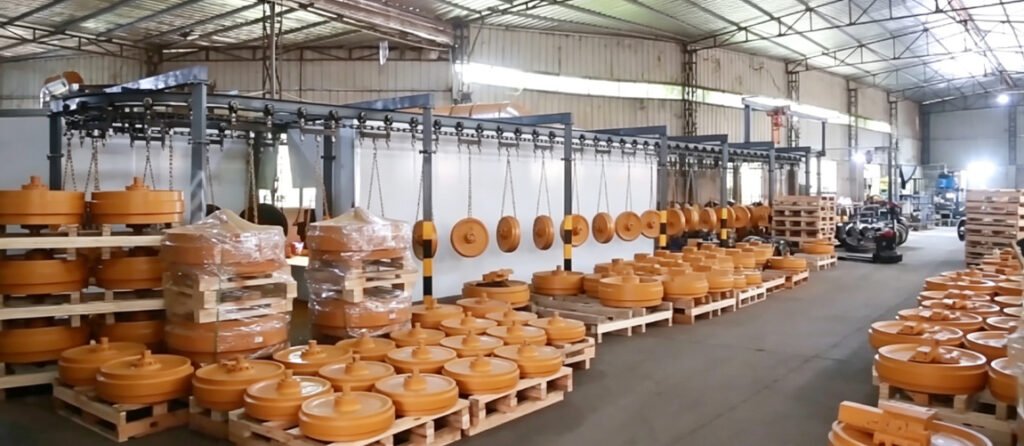
As a manufacturer specializing in excavator undercarriage parts since 2011, GFM has established an integrated system covering materials, processes, and quality control for excavator idler wheels, ensuring stable performance under heavy-load and complex working conditions.
Manufacturing Capability: Stable and Reliable Full-Process Industrial Production
GFM’s manufacturing strength is built on a complete industrial production chain. Through coordinated control of materials, optimized processes, and scalable production capability, we ensure consistent high-performance output of excavator idler wheels.
- High-Strength Material Foundation: Premium alloy steel and high-grade cast steel are used to enhance impact resistance and wear performance from the source, while ensuring batch consistency and material stability.
- Precision Forming Process: By combining casting and forging technologies with high-precision machining equipment, the wheel structure achieves higher density and stability, improving overall operational reliability.
- Controlled Heat Treatment Process: Multi-stage heat treatment, including quenching and tempering, is applied to optimize internal material structure, achieving an engineering balance between hardness and toughness.
- Flexible Production Capacity System: The factory supports both large-scale stable production and OEM/ODM customization, meeting diverse requirements from different brands and machine models.
Through a fully integrated manufacturing system, GFM ensures that every excavator idler wheel delivers long-term structural strength and reliable performance under real working conditions.
Quality System: Multi-Level Inspection and Global Application Validation
GFM has established a comprehensive quality control system that covers the entire production process, ensuring every product meets stable and reliable standards before shipment through multi-layer inspection and field validation mechanisms.
- Precision Dimensional Inspection: Critical dimensions and tolerances are strictly controlled to ensure installation compatibility and reduce track operation issues caused by deviation.
- Systematic Performance Testing: Hardness testing and structural consistency verification are conducted to ensure stable performance under high-impact and long-term working conditions.
- Comprehensive Final Inspection Process: Multi-stage sampling inspection focuses on rotation smoothness, sealing integrity, and structural completeness to reduce batch variation risks.
- Extensive Brand Compatibility Capability: Products are compatible with major excavator brands such as Caterpillar, Komatsu, Hitachi, Volvo, and SANY, with structural optimization available for different models.
- Стандартизированная система обеспечения качества: A warranty of at least 1 year or 2000 working hours is provided, validating product reliability through real-world applications rather than laboratory data alone.
Through a strict quality system and global application validation, GFM continuously reduces failure rates and maintenance costs of excavator idler wheels in real-world operations.
| Получите быструю бесплатную расценку | Электронная почта: henry@gfmparts.com | Вотсап: +86 17705953659 |
The excavator idler wheel is a critical load-bearing and guiding component in the excavator undercarriage system. Its performance stability directly affects machine operating efficiency, track service life, and overall maintenance costs. From structural design and failure mechanisms to scientific maintenance and supplier selection, every aspect determines the equipment’s reliability under complex working conditions.For procurement professionals, a truly valuable excavator idler supplier is not only defined by dimensional compatibility, but also by a stable material system, mature manufacturing processes, and strict quality control capabilities that reduce failure risks at the source.
Since 2011, GFM has been dedicated to the manufacturing of excavator undercarriage parts. Through continuous process optimization and quality system improvement, we provide highly reliable excavator idler wheel solutions to global customers, helping reduce downtime and improve overall equipment efficiency.
If you are looking for a stable long-term supplier or require OEM/ODM customization support, please contact GFM. We are committed to providing professional and reliable supply solutions for your projects.